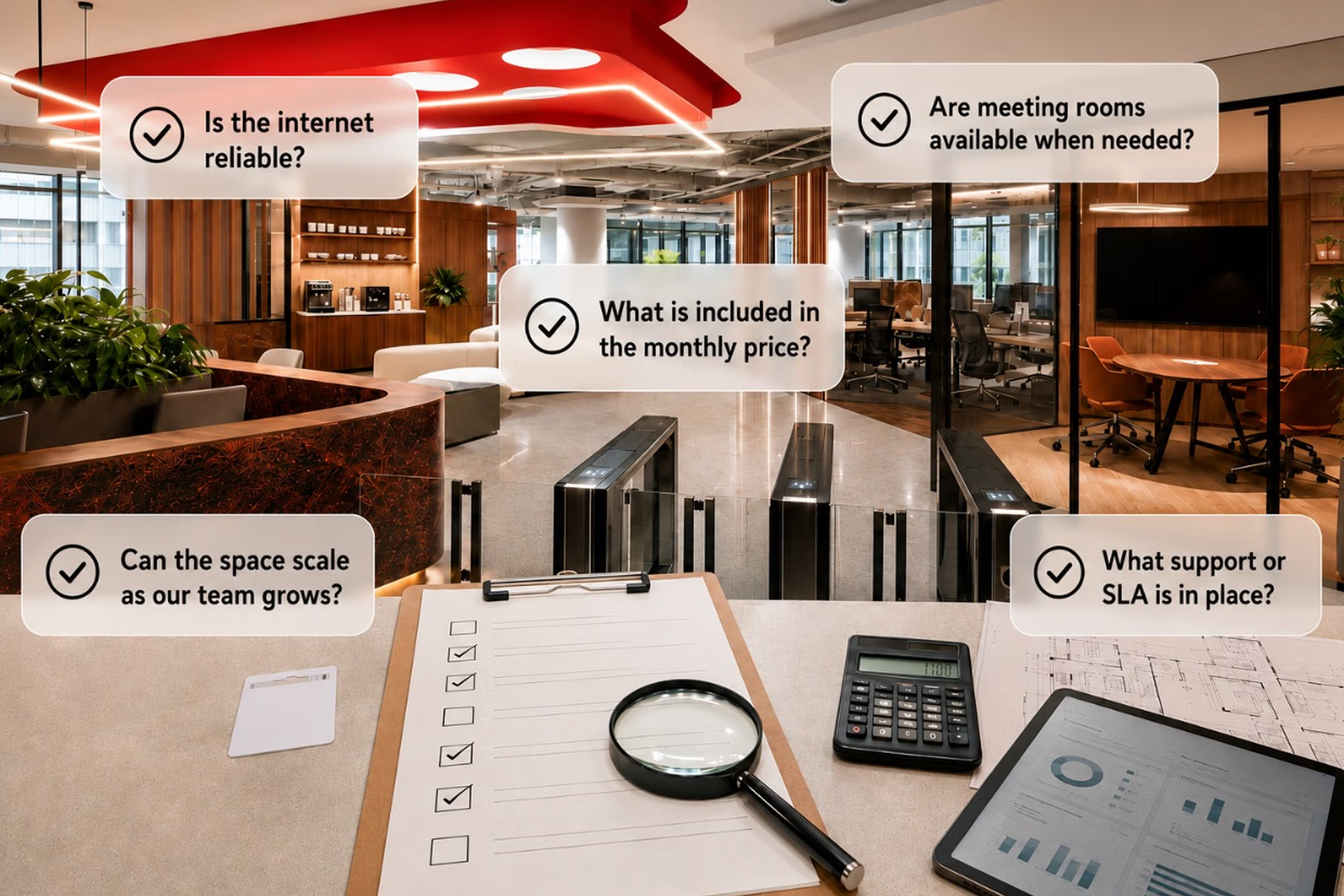
There's a particular kind of regret that hits operations leaders about three months into a bad workspace decision. The internet keeps dropping during client calls. The meeting rooms are always booked. Fixing a busted air conditioner takes the support team fourty-eight hours by their schedule. Hidden toward the back pages of your contract sits a clause locking you in for one and a half years more.
This guide exists so that doesn't happen to you.
Choosing a coworking operator sounds like a straightforward procurement decision. It rarely is. The operator you choose affects your team's daily productivity, your ability to scale quickly, your monthly cost structure, and your company's ability to look credible to clients and talent alike. Getting it right requires the same rigor you'd apply to any other significant vendor decision.
Why Some Coworking Spaces Work Better Than Others
Most companies start evaluating coworking spaces by looking at price per seat and location. Both matter. But they're usually the easiest variables to compare and often the least important ones once you're actually operating.
What's harder to evaluate upfront, and what tends to make or break the decision, is reliability. How consistently does everything work? Who do you call when something doesn't? How quickly do things get resolved?
The coworking operator you choose also shapes your employees' experience in ways that go beyond the physical space. Commute distance, building quality, cleanliness, ambient noise, access to meeting rooms, whether the coffee situation is decent. These details add up. Companies that overlook them find out soon enough, usually through attrition numbers or candid feedback in exit interviews.
From a cost standpoint, a workspace that looks cheap per seat can get expensive quickly once you account for hidden costs in coworking like premium meeting room charges, printing fees, guest access charges, and infrastructure add-ons that weren't in the original quote.
The right operator makes operations easier. The wrong one adds operational load you didn't budget for.
What to Check Before Signing With a Coworking Operator
Go through this section carefully. These questions focus on the practical issues that can affect day-to-day operations after you move in, including infrastructure reliability, meeting room access, support, costs, scalability and contract terms.
How to Check Internet, Meeting Rooms, and Office Infrastructure?
Is The Internet Actually Reliable?
Not just fast on a speedtest. Reliable. Ask what the uptime guarantee is. Ask what backup systems exist if the primary connection goes down. Start by checking the number of people using the network at once. See if a separate connection is available when your group requires stable internet.
Most people gripe about laggy internet when trying out coworking spaces in Bangalore - also one of the simplest things to check ahead of time. To test the internet reliability in coworking spaces, try dropping by while it is busiest.
Are Meeting Rooms Accessible When You Actually Need Them?
Meeting room availability can look adequate during a tour but become restrictive during peak hours. Ask the operator for practical details: How many meeting rooms are available relative to the number of members? How far in advance can rooms be booked? What does availability typically look like during peak hours?
Also check whether meeting room hours are included in your plan, whether monthly limits apply, and what additional usage costs after the included allowance. If regular client calls or team meetings are important to your business, review the booking process before signing.
Is The IT Infrastructure Built For Professional Use?
IT infrastructure in coworking goes beyond internet. Ask about VLAN options, firewall configurations, VPN compatibility, and whether dedicated networking is available for teams with data security requirements. Generic shared WiFi might work for a freelancer. It doesn't always work for a 20-person team handling sensitive client data.
Cost and Transparency
What Exactly Is Included In The Monthly Price?
Get a fully loaded cost sheet. Not a brochure. Go through each possible charge you might see on your bill. Think electricity, cleaning services, safety staff, visitor tags, time in shared rooms, pages sent to print, car spots, storage bins. Spot which ones come covered. Notice which ones arrive with extra fees later. Know where each cost lands - inside or outside the base price.
The advertised seat price may not represent the total cost of occupancy (TCO). Your TCO should include the base workspace fee plus any additional recurring or usage-based costs, such as meeting room overages, parking, printing, guest access, storage, utilities or premium network requirements.
Comparing the full TCO across operators gives you a more realistic view of what each workspace will cost your business.
Are There Usage-Based Charges That Could Vary Month to Month?
Variable charges are fine if you understand them. They become a problem when they're unexpected. Hours in a meeting space might cost extra once you go past what your plan covers each month. Guests could add fees when their number climbs too high. Power use brings charges if it crosses an invisible line. Get an example bill from companies like yours. See how costs stack up on your ledger.
Will the Workspace Still Work When Your Team Grows?
Can You Add Seats Without Signing a New Agreement?
Seat flexibility is one of the clearest indicators of how founder and operator-friendly a coworking company actually is. Ask what the process looks like for adding five seats in the next quarter. Does it require a new contract? A different space? A waiting period?
Office space scalability matters more to growing companies than almost any other factor. One year down the line, will there still be room for everyone? Picture desks filling fast, then ask about actual limits on people per floor. Growth sounds fine when it is still theory - until you’re turning staff away at the door due to space constraints. Watch how moves happen between zones; some shifts take days, others just hours. Space that fits now might pinch later, so check when it starts to bulge.
Are Both Short-Term and Long-Term Plans Available?
Contract flexibility in coworking varies widely. Some operators insist on 12-month minimums. Others offer monthly arrangements.
Start by analyzing your choices out there. Look at how much each one costs compared to the others while figuring out which path stretches your resources farthest with minimal baggage.
What to Check in a Coworking Agreement Before Signing
What is the Lock-in Period and What Does Breaking it Cost?
The lock-in period for coworking agreements doesn't get enough attention at the evaluation stage. Start by asking exactly how long the commitment lasts. What happens if you leave sooner than planned? Find out about cutting down seats - does that count as canceling everything? See if it's handled differently in different coworking spaces. Get clarity before moving forward.
Are Exit Clauses Written Clearly?
Ask for the exit clause to be walked through with you. What's the notice period? What conditions allow you to exit penalty-free? If the operator fails to deliver on infrastructure or service commitments, is that a valid basis for exit? Get these answers in the agreement itself.
What Happens When Something Breaks in the Office?
Is There Dedicated On-Site Staff?
On-site operational support can make a meaningful difference when facilities or access issues arise. Ask whether the location has a dedicated reception or facilities team, what hours they are available, and who takes ownership when something goes wrong.
Also understand the escalation process. If an issue cannot be resolved by the on-site team, who handles it next, and how is progress communicated to your team?
What Does the SLA (Service Level Agreement) Look Like?
When issues such as internet outages, HVAC failures or access problems occur, ask how the operator defines response times, resolution targets and escalation procedures.
If service commitments are documented in an SLA or agreement, review what is covered and how critical and non-critical issues are treated differently. It is also worth asking how previous service incidents were handled and speaking with existing clients about their experience with support and resolution times.
How is Maintenance Handled?
When you think of uptime and maintenance in a coworking or managed office space, it is important to ask a few mundane questions: Do you use a ticketing system to raise issues when they occur? Is there a maintenance schedule to ensure problems don’t arise? How long does it take before the ticket is raised and the fix has been provided?
The seriousness of an issue plays a role too. Because a broken chair is far less troublesome compared to a broken AC in peak Bangalore summers.
How Secure Is the Coworking Space Really?
What Access Control Systems are in Place?
Security and access control in coworking covers building entry, floor access, cabin access, and server room or data room security if relevant. Find out whether access is card-based, app-based, or biometric. Ask what happens when a team member leaves and how access is revoked.
How is Physical and Data Security Managed?
Start by checking if there’s video monitoring on site. See how visitors are tracked when they come in. Find out if security staff are present at all hours. If your team works with private client details, question whether the facility follows recognized data protection rules. Look into whether the manager holds official credentials for keeping information safe. A secure coworking environment is not a given. Verify it.
Does the Coworking Space Match Your Company Culture?
Does the Operator's Community Match Your Company's Profile?
This might feel like a soft criterion, but it's a real one. If you're a B2B SaaS company and the space is filled primarily with solo freelancers and content creators, the energy and networking opportunities will be different from a space where your neighbours are other funded startups and growing SMEs.
Beginest's entrepreneurial community across eight Bangalore locations has been built with exactly this in mind. You can’t put a number to quantify the importance of the connections you make at a coworking space. But, you can imagine for yourself an environment with over 200 startups sharing the same business ecosystem. It can only be experienced, not explained. You could always show up at any Beginest Coworking Space in MG road or Indiranagar to know what we are talking about for yourself.
Does the Space Reflect the Image Your Business Wants to Project?
A room where clients step inside, teams gather, or newcomers form their initial thoughts - does it say what you truly mean? Think about how it feels when someone walks in.
Evaluating workspace options for your growing team?
Beginest offers fully managed offices with transparent pricing, reliable infrastructure, and flexible plans built for startups and scaling businesses.
Mistakes Companies Make While Choosing a Coworking Space
Even experienced COOs get this wrong sometimes. Usually for predictable reasons.
- Optimizing on price per seat. Most of the time, a cheap ticket doesn’t save money overall. When companies set low base prices, they often balance it with hidden fees, skimp on equipment upkeep, or reduce customer help options. What looks like a bargain at first can wind up costing more. Balance shifts without warning.
- Ignoring scalability until it's urgent. Later problems start early. When fifteen folks fit fine, thirty can feel tight fast. Growth waits for no lease to end. Costs pile up once walls close in. Begin by asking room to grow. Realizing too late means paying more later.
- Overlooking SLA clarity. A nice-looking space with no formal service commitments is a support gamble. At some point, something will break or underperform. Whether that gets resolved in two hours or two weeks depends on whether the operator has actual accountability built into the relationship.
- Taking the sales tour at face value. Drop by without warning, if you can. Start chatting with people who aren’t stuck in a tour led by sales staff. Find out what keeps failing, how help shows up when it does, and what they’d tell their past self before agreeing to anything.
Coworking vs Managed Office vs Traditional Office - Which One Makes Sense?
| Factor | Traditional Lease | Coworking Space | Managed Office |
|---|---|---|---|
| Setup Cost | High | Nil | Nil |
| Lock-in Period | 2 to 5 years | Monthly to 12 months | Flexible, often quarterly |
| Privacy | Full | Shared open desks | Private cabins available |
| Scalability | Difficult | Limited by availability | Easy to adjust |
| SLA / Support | None | Varies widely | Structured |
| Customization | Full (at your cost) | Minimal | Moderate to high |
| Hidden Costs | High | Medium | Low |
| Internet Reliability | Self-managed | Shared, variable | Managed and backed up |
| Best For | Large stable teams | Solo to small teams | Startups to mid-size companies |
The coworking vs managed office comparison usually comes down to control and predictability. A generic coworking space gives you a desk and a shared connection. A managed office gives you a full operational setup with someone responsible for keeping it running.
For COOs specifically, managed offices remove a category of operational overhead that coworking spaces often introduce.
Why Growing Companies End Up Choosing Managed Offices
The pattern repeats often enough that it's worth naming. A company starts in a coworking space. It works well for the first six to eight people. Then the team grows. The shared meeting rooms get crowded. The internet feels slower during peak hours. The lack of privacy becomes a problem for client calls and sensitive conversations.
At that point, the company starts looking at managed offices.
- Customization. A managed office can be set up to reflect your brand, your workflow, and your team's specific needs. That's harder to do in a generic shared environment.
- Reliability. A fully managed office with structured support and defined SLAs delivers a more predictable operational experience than most shared coworking setups.
- Better cost control. One monthly number covering everything is easier to budget around than a base seat cost plus variable add-ons that change month to month.
- Plug and play readiness. Beginest's true plug and play setup means your team walks in and starts working. No vendor coordination, no setup delays, no facilities headache for your admin team to absorb.
Want a workspace that actually works as hard as your team?
Beginest has private cabins, high-speed internet, and full management built in. Managed Office Spaces Near Indiranagar and MG Road - Transparent pricing - No surprises.
A Quick Checklist Before Finalising Any Coworking Space
This checklist is sure to come in handy the next time you visit a coworking space in Bangalore for evaluation:
Infrastructure
- Internet uptime guarantee and backup connectivity
- Meeting room availability and booking process
- IT infrastructure and security network options
- Physical maintenance schedule and response time
Cost and Transparency
- Full loaded cost per seat
- Variable charges and usage-based billing
- Total Cost of Occupancy (TCO) calculation
- Comparison with at least two other operators
Flexibility and Contract
- Lock-in period and exit clause terms
- Seat addition and reduction process
- Short-term plan availability
- Penalty for early termination
Operations and Support
- On-site staff and support hours
- SLA for issue resolution
- Escalation path for major incidents
- References from existing clients of similar team size
Security
- Access control systems
- CCTV and visitor management
- Data security policies
Fit and Culture
- Community profile and networking quality
- Client-facing presentation of the space
- Brand alignment
If an operator can't answer most of these questions clearly, that's your answer.
Frequently Asked Questions
1. What should a COO prioritise when evaluating a coworking space?
Start with infrastructure reliability and support quality, then look at cost transparency and scalability. A coworking space evaluation checklist for operations leaders should always include SLA terms, internet uptime guarantees, meeting room availability, and the full loaded monthly cost. Aesthetics matter but they rarely cause operational problems. Internet that drops during client demos does.
2. What are the most common hidden costs in coworking spaces?
Hidden costs in coworking typically include meeting room charges beyond a monthly allowance, guest access fees, printing and hardware charges, parking, locker rental, premium internet or VLAN setup, and sometimes even cleaning or utilities billed separately. Always ask for a fully itemized cost sheet and a sample invoice from a team of comparable size before comparing options.
3. What is the difference between a coworking space and a managed office?
A coworking space is primarily a shared environment with hot desks or fixed desks in an open setting. A managed office offers dedicated, private space that is fully set up and operationally managed on your behalf. Managed offices typically come with structured SLAs, dedicated support, and greater customization options. For teams above 10 to 15 people who need privacy and operational predictability, managed offices usually make more sense than coworking.
4. How do I evaluate an operator's SLA before signing?
Ask for the SLA document, not a verbal description. Check the response times for critical issues (internet failure, power backup, access failures) versus non-critical ones (furniture, general maintenance). Ask what happens if the operator fails to meet the committed timeline and whether there are penalties or credits. Also ask current clients how the operator has handled real incidents. A service level agreement in coworking is only as good as the operator's actual track record.
5. Can a coworking space support a team that's growing fast?
It depends on the operator. Many coworking spaces are effectively at capacity and can't accommodate sudden seat additions without a waitlist or relocation to another floor or building. Before signing, ask specifically how the operator handles fast-scaling teams, what the process looks like for adding 10 seats in 60 days, and whether that's possible within the same space or requires a new agreement. Office space scalability is one of the most important variables for any company that expects to grow.
Conclusion
The workspace decision isn't just a facilities call. It's an operations call, a finance call, and a culture call all at once. The operators who understand that tend to build better spaces and better relationships with the teams that use them.
Beginest has spent years building managed workspaces that work the way growing companies actually operate. Eight locations across Bangalore, 1000 plus members, and 200 plus startups who call it their home away from home.