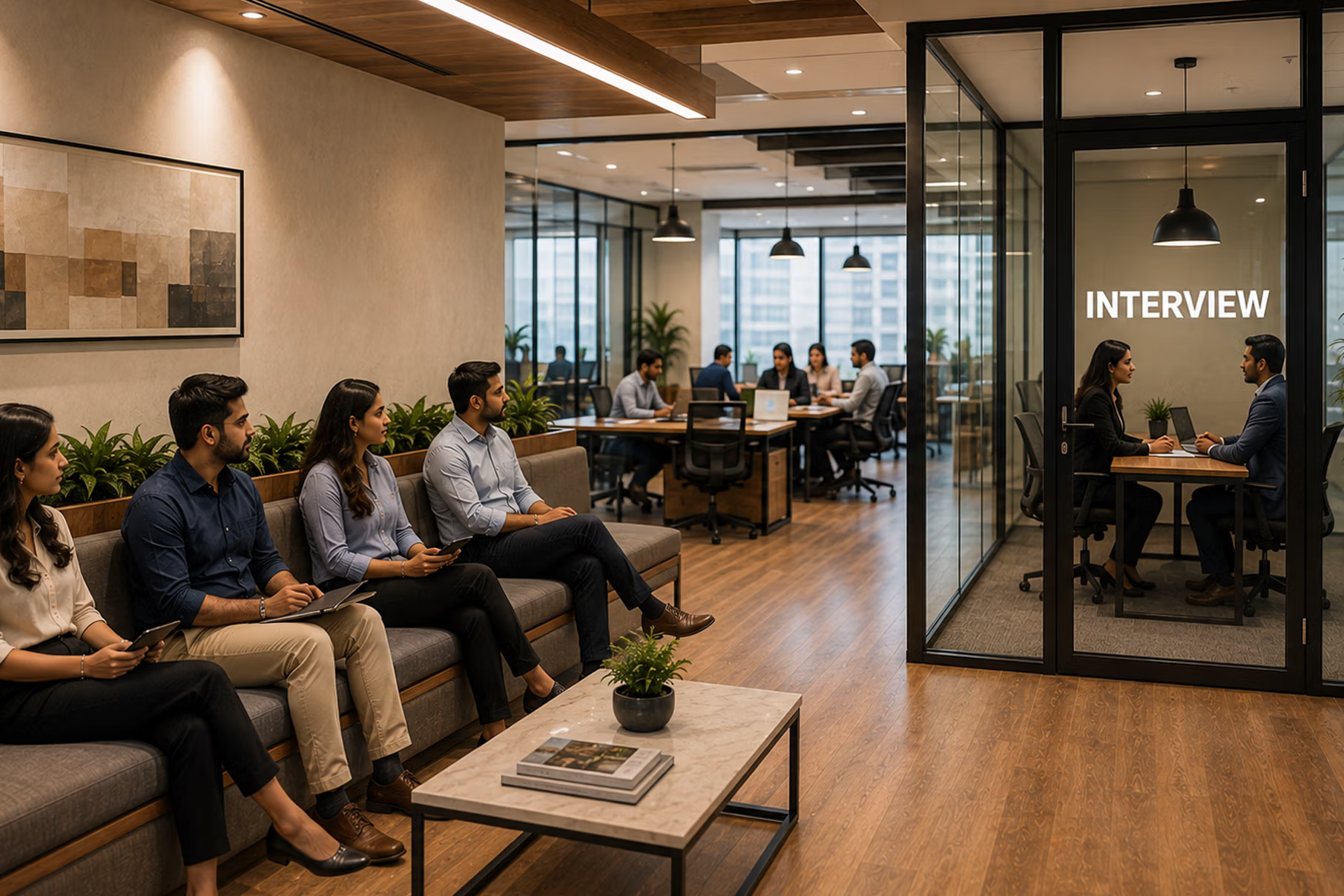
There's a moment every CHRO and CEO has experienced a million times: You've found the right candidate. The interviews went well. Everyone's agreed on compensation. And then the offer stalls, or worse, the candidate accepts another offer based on some nebulous "work environment" or "team culture" concern. You nod, shake your head, and move on.
What's not always talked about, however, is the part that the actual work environment played in the decision-making process. Commute times, the impression the office building makes, whether the office feels like a place where careers actually go somewhere - all of these are not always part of the exit interview, but they're part of every decision every single day.
Hiring velocity, of course, has always been a logistics game for the competitive markets like the tech and startup ecosystem of Bangalore. Companies that can hire candidates faster, and keep them for longer, have always been the ones that have somehow managed to figure out what the rest have not: the value of the actual work environment, whether they're managing it or not.
The Talent Market in Bangalore Is Not Getting Easier
Bangalore is the hiring hotspot for tech, product, and startup talent in the country. It is also one of the most competitive. The very profiles that a funded startup is competing for are also being competed for by GCCs, multinational product companies, and a dozen other growth-stage startups that are making aggressive offers at the same time.
The hiring pool in this market is not looking at the overall compensation. They are looking at the overall picture. Who are the people around me? What does the office look like? How far is it from where I live? Will I end up wasting 90 minutes each way on the road every day?
The CHROs who understand this have begun to look at their workplace not as an afterthought managed by their admin teams.Flexible workspaces have evolved from a convenience for startups to a norm for talent. The companies that still do not get it and treat them as a necessity are falling behind the ones who do.
Bangalore's flexible workspace market by the numbers:
Bengaluru leads India in flexible workspace supply, accounting for 32% of total flex inventory across the top six cities. (IBEF, December 2024)
Flexible workspace operators recorded 12.4 million square feet of gross leasing volume in 2024, a 57.5% year-on-year growth. (Cushman and Wakefield, 2025)
Companies aiming to attract and retain talent in a competitive market are increasingly choosing managed office solutions as their leasing strategy, with this cited as one of the primary demand drivers. (Cushman and Wakefield)
54.1% of India's flexible office demand in 2024 came from enterprise clients, signalling that it is not just startups choosing coworking anymore. (Mordor Intelligence)
Location Is a Hiring Decision, Not a Real Estate One
When a candidate is presented with two job offers, the first thing they want to discuss is usually the compensation. However, it is not the only factor at play. Research indicates that one of the key influencers for a candidate accepting a job is the commute time. And in a city like Bangalore, the commute is a huge factor.
If a job requires 80 minutes each way through peak hour traffic, it is not the same job if the commute is 25 minutes via the metro. For candidates who have families, projects they need to attend to, a gym routine they need to get to, or any semblance of a life outside work, the commute is not a hypothetical situation. It is a cost they incur each day.
This is where the coworking spaces around the metro stations on the more accessible routes such as Indiranagar and MG Road come into play. The candidate knows
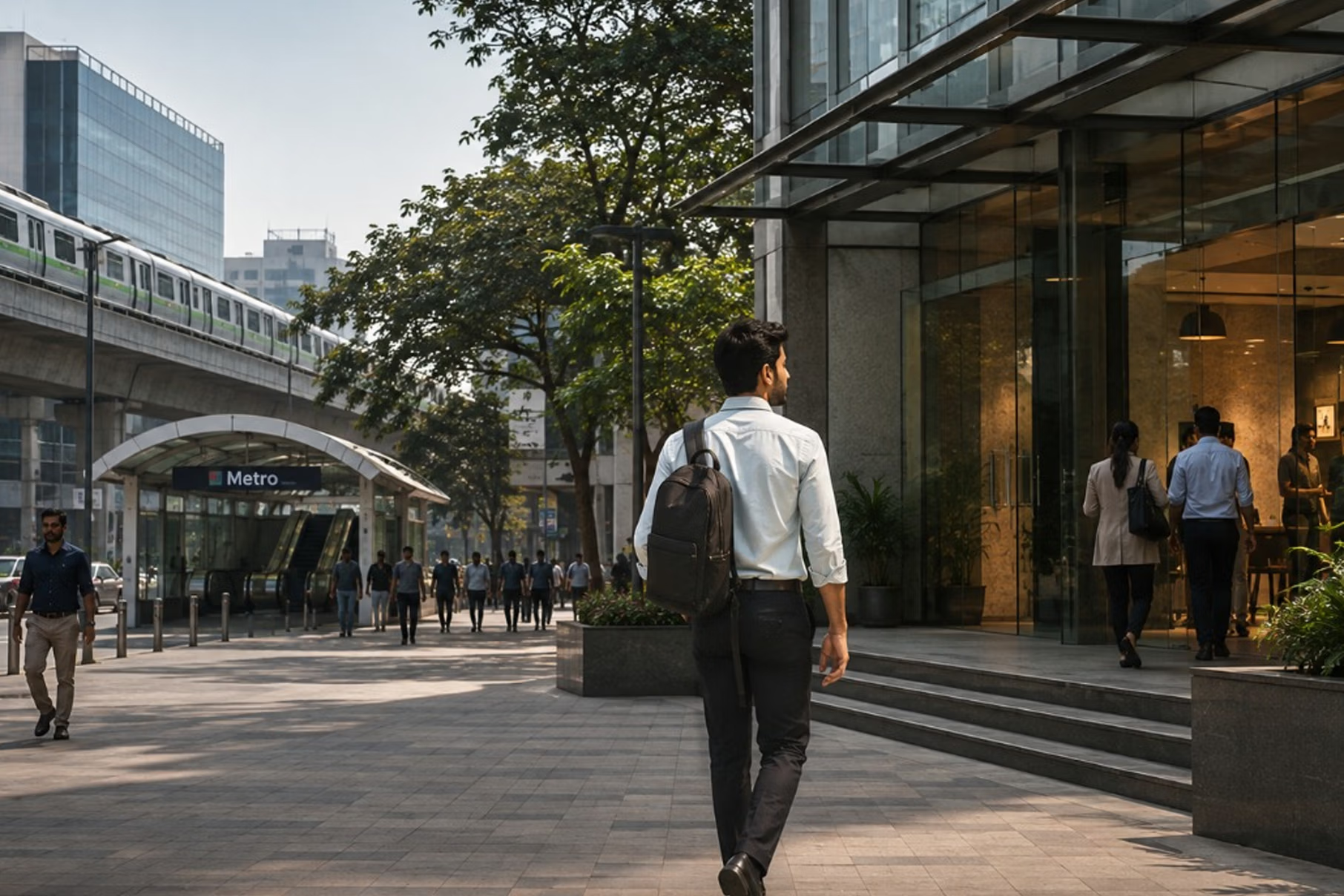
What a central, accessible location actually signals to a candidate:
- The company thinks about the people who work there, not just the real estate budget
- The leadership team understands that time outside the office has value
- The workspace is part of a professional environment, not an afterthought
- Showing up won't be a logistical ordeal
These factors may become more important when candidates are comparing roles with similar compensation and responsibilities. Factors such as commute, workspace quality, flexibility and the overall employee experience can influence how attractive one opportunity feels compared with another.
Give Your Next Great Hire a Reason to Say Yes
Beginest's fully managed coworking spaces across Bangalore are built to close candidates faster.
Prime locations in Indiranagar and MG Road,
high-speed internet, private cabins, and a community of 200+ startups.
4000+ members | 8 locations
Importance of a Coworking Space in Attracting Top Talent
Every business understands that the interview process plays a significant part in how the candidate perceives the business. Even fewer pay attention to how the business itself is communicating during this process.
Consider this: how does a candidate perceive a business when they walk in for an interview in a completely unmanaged office space? Not only is the reception area unidentifiable, but the space itself looks like it has been cobbled together to accommodate the lack of infrastructure. A good candidate makes a determination about this in a matter of minutes. Whether or not this determination is correct is irrelevant. First impressions in hiring are exactly that: first impressions decide the workplace impact on employee retention.
A secure, spotless, and professionally managed workspace sends a different message to a potential employee. Walking into a well-managed space sends a message to a potential employee that this is a business that operates with care. That this is a business that understands that their employees are making a bet on this business.
One of the underrated benefits of a fully managed coworking space is that the professional standard is guaranteed and maintained. You are not relying on your admin team to have had a good week. The facility is consistently clean, consistently staffed, and consistently functioning. That consistency is a quiet but real signal to every candidate who walks through the door.
What the data says about flexibility and talent decisions:
In a 2024 WeWork survey, 59% of companies planning to expand workspace in the next two years said they are choosing flexible space over traditional offices, primarily to attract and retain the right talent.
Hybrid work models are now standard across 77% of companies globally, making flexible workspace infrastructure a baseline expectation for senior hires rather than a bonus. (Allwork.Space, 2025)
Companies using flexible workspaces report reducing real estate costs by up to 30% per desk while offering top-tier amenities, allowing those savings to be redirected into compensation and benefits. (Mordor Intelligence)
The flex workspace market in India is projected to reach USD
Flexibility Closes Candidates That Compensation Cannot
There is a cohort of senior candidates. They are the ones who most companies are trying to win over. They are not motivated by a salary increase at this stage in their career. They have options. What they are looking for is autonomy, environmental quality, and a sense of proof that the company can execute on its promises.
Workspace flexibility is one of the things that resonates. If a CHRO can say to a candidate: we're a true plug-and-play managed office. We've got the infrastructure. We've got privacy. We've got the community. This is maturity. This is a company that doesn't wing it. This is a company that has got the fundamentals right.
Flexibility also helps protect companies in growth phases. A team that grows from 18 to 40 people in six months is not well-supported by a fixed lease that was negotiated when they were at a lower headcount. A managed cowork space absorbs this growth without burdening the leadership with a crisis-level real estate decision at precisely the time they should be focused on scaling.
This is also a story about talent. When a senior leader asks, "What if this company grows fast?" the answer should be about a space infrastructure that grows with the business.

Community as a Hidden Hiring Asset
But there's another less obvious way that coworking drives hiring, one that most HR teams aren't tracking: the community effect.
The truth is that a well-curated entrepreneurial coworking community is not just good for the entrepreneurs already within the organization. It's also good for the organization itself. Founders in adjacent spaces become introductions. Operators in adjacent spaces become future employees when the time is right. Coffee breaks in a shared space become a source of qualified referrals.
Beginest's network of over 200 startups and 1000 members across 8 locations in Bangalore is precisely this: ambient access to a larger pool of qualified employees. Not a formal pipeline. Not a formal process. But better than that: a living space where the right people are already around you.
For CEOs looking to speed up their hiring processes without inflating their recruitment budgets, this is a real differentiator. Referral-based hiring is faster to close, longer to retain, and cheaper to acquire than traditional agency-based or job-board-based hiring.
A candidate decides what kind of company you are before the interview starts.
Secure, spotless, consistently managed — Beginest workspaces make the right impression
without you having to stage it.
What Fast-Hiring Companies Have in Common
Across the Bangalore startup and scale-up landscape, the companies with the strongest hiring velocity also share a few key characteristics. Their workspace is not a topic they need to apologize for during a hiring conversation. Their location is something they can speak to with confidence. And the overall office environment is one where the new employee knows the company is a well-run organization from the get-go.
None of this is happenstance. This is a result of decisions made with intent, usually by a CHRO or CEO who recognized the workspace is not only a part of the hiring equation; it is not separate from it.
Having a fully managed coworking space in Bangalore with high-speed internet access, private cabins, professional meeting rooms, and locations with access to the metro is not only beneficial for the operation of the company; it is beneficial for the hiring process. It is something you can speak to with confidence during a hiring conversation: one fewer thing for the candidate to question.
The Workspace Conversation You Should Be Having Before the Hiring One
The teams with the strongest hiring velocity in the Bangalore talent market were not those with a more refined JD or a more aggressive compensation strategy. It was those teams where the entire equation was dialed in. The job itself made sense. The company itself looked like a real company with a sense of gravitas. And the workspace itself—the physical space where the employee was going to be spending the next X months or years—was one where the employee was comfortable saying yes without any hesitation.
If your workspace is not helping with the latter, or worse yet, is creating friction with the latter, then you’re a problem with a solution. And the solution compounds into a return on investment that extends far beyond the hiring itself.
Beginest’s managed coworking spaces on Indiranagar, MG Road, and 6 other locations across Bangalore are designed with the needs of modern teams in mind: professional from day one, agile as you grow, and embedded with the kind of community that makes employees want to stay.
Frequently Asked Questions
1. How does office location affect hiring speed for startups and scale-ups in Bangalore?
Location affects candidate decisions in ways that rarely get surfaced directly. Commute time is consistently rated among the top reasons candidates accept or reject offers, particularly in a city like Bangalore where traffic is a real daily cost. A workspace in a well-connected, recognisable area like Indiranagar or MG Road, close to metro stations, reduces commute anxiety for candidates during the decision-making phase. It also signals that leadership understands employee quality of life, which matters especially to senior and specialist hires who are evaluating the whole picture before saying yes.
2. Can a coworking space genuinely support enterprise-level hiring needs?
A fully managed coworking space designed for business use cases provides private cabins, meeting rooms, high-speed internet connectivity, and a secure environment that meets the needs of an enterprise, all without the cost of a traditional office build-out. As Mordor Intelligence reports, enterprise users represented more than 54% of India's flexible office space demand in 2024, demonstrating the pervasiveness of the trend. The environment is business-like, the infrastructure is robust, and the flexibility is conducive to the fluctuating headcounts of an active hiring cycle.
3. How do managed workspaces help with talent retention, not just acquisition?
Retention is also affected by the experience of the workplace itself, and the physical space is one part of that. A secure, clean, well-managed space eliminates operational friction for the team, ensures that the space is managed to a consistent standard, and supports the kind of focused work that keeps people engaged. Commute convenience, professional space, and the presence of an entrepreneurial community around the workplace also help employees feel that the company has thoughtfully considered where and how they work, which is also a part of employee retention.
4. What role does workspace flexibility play in closing senior hires?
Senior-level candidates, especially those who have experience and alternatives, are not only considering the monetary rewards. They are also looking to ensure that the company is a well-run organization with its fundamentals in place and cares about the working environment of its people. A plug-and-play managed office is a way to communicate all of this without having to present a deck. Flexibility is also an important aspect to consider. This is especially true for senior-level talent, who can see if the company is built to scale beyond optimistic hiring models.
5. How does being in a coworking community affect the quality of referral hires?
Referral hiring is always the fastest and highest-quality hiring source for any company, and a well-curated coworking community is the key to creating the right conditions for referral hiring to occur naturally. When you’re plugged into a community with other founders, operators, and professionals from 200+ startups and over 1000 members across Bangalore, the organic conversations that lead to hiring happen naturally. Warm sources come pre-vetted through existing relationships, convert faster, and stick around longer.