
We've seen hundreds of founders and managers work through the logistics of managing distributed teams from our spaces. The pattern we've seen is this: most arrive thinking the challenge is purely logistical - how to coordinate across time zones, how to run meetings when half the team is on Zoom, how to keep tabs on work without walking over to someone's desk.
Those challenges are real. But one challenge that cannot be overlooked is mental presence. When you're physically present in a workspace and your team is scattered across cities, the challenge becomes: How do you stay connected to what they're doing without losing presence in the environment you're in? How do you get this balance right? Because if you get it wrong, you'll drain the life out of everyone involved.
If you're managing a remote team and working from a coworking space, here's all you need to know!
1. Pick the Right Coworking Space for Your Needs
Of course, not all coworking spaces are built for this. Some are built for individual work, heads down, no interaction necessary. Others are built for community and networking but may not have the facilities for operational work. When you are trying to run a team remotely, you need something a bit more specific:
- Internet connectivity with proper backup
- Meeting rooms for video calls
- Quiet areas for when you need to concentrate
- A general feel that doesn’t interfere with you trying to run operations across many locations.
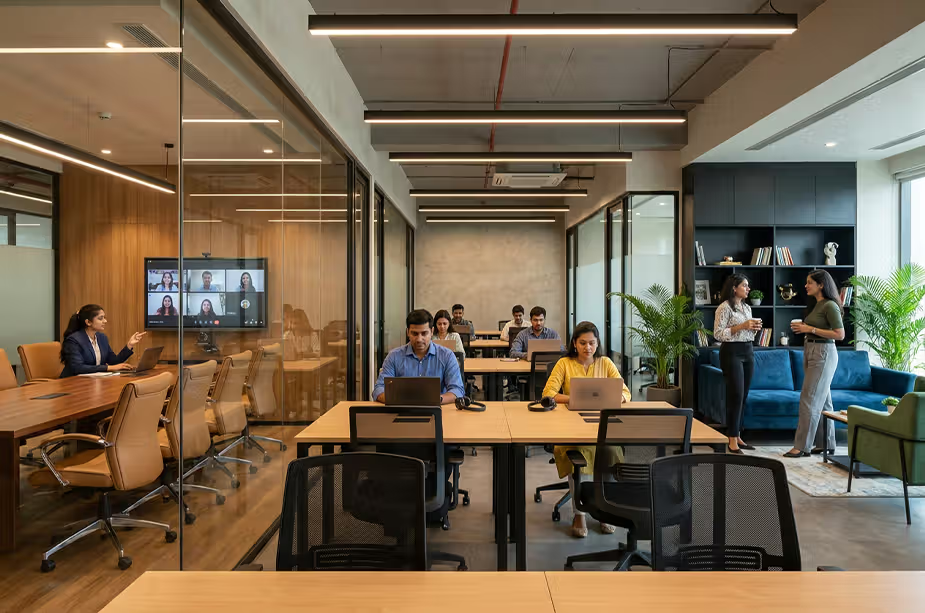
At Beginest coworking spaces in Bangalore, we have designed our coworking spaces in Indiranagar and coworking spaces in MG Road keeping exactly this scenario in mind.
- Tech-enabled meeting rooms where video calls are never laggy.
- Reliable connectivity that does not drop midway through a sprint planning session.
- Private spaces for better focus
- Collaborative spaces for better group discussions.
This is because the last thing you want when trying to manage a distributed team is for your own workspace to be the biggest obstacle in the way.
2. Leverage Technology to Stay Connected
- Every team has Slack or Teams or some other form of communication.
- Most teams use Asana, Trello, or Bitrix24 as a project management tracker.
- Everybody uses Zoom or Google Meet for video meetings.
The tools, in and of themselves, are no longer differentiating factors. What makes a high-functioning remote team different from those teams that seem to have no process or structure in place is not the tools they’ve chosen to use, but the structure and discipline they apply to those tools.
Do the teams have clear goals and purposes for the different channels? Do the teams have clear deadlines and expectations for the tasks? Do the teams have clear agendas and expectations for the meetings, where most of us are used to magically creating the agenda in the first five minutes of the meeting?
If you’re in a coworking office or a managed office space, your environment actually has the power to reinforce the structure and process. Your structure and process in the office will actually dictate the structure and process for your remote teams. If you block time in your calendar for focused work, your remote teams will respect those blocks. If you conduct your meetings in a professional manner with a proper setup, your remote teams will follow suit.
The technology does the heavy lifting, but only if we give it clear instructions.
3. Establish Clear Expectations
Remote teams fail when things are not clearly defined. What are working hours when team members live in different time zones? How quickly should one respond to someone’s message? What is "done" with one task or another? Without these definitions, one can only assume things, and assumptions never work well.
Write it down.
Working hours, the way we communicate with each other, the way we measure progress towards the goal, the way we make decisions; these things do not have to be set in stone, but they need to be clearly defined.
One of the great things about working in a coworking space is that you can actually be the example yourself. Your team, remote or occasionally present in the office, will be able to gauge their behavior based on your example.
This is one of the key aspects of remote work best practices: being an example yourself, not just providing your team with a rulebook full of guidelines.
Your remote team needs clarity. Your workspace should support it.
4. Make Use of Private Meeting Rooms for Brainstorming
A co-working space provides you with a physical location where your remote employees do not. Take advantage of that when necessary.
Meet in a meeting room to conduct a brainstorming session where a whiteboard and live dialogue will get the job done much better than yet another video conference. Bring your in-office employees to a meeting to conduct a planning or strategy session. Being in the same room will change the entire dynamics of the conversation from lethargic to action-oriented.
For your remote employees, engage them through the video system in those rooms. If done correctly, hybrid meetings will work. However, intentionality is the keyword. Do not automatically fall back on in-person meetings because you can. Fall back on in-person meetings when the format actually works better for the goal than a video conference would.
5. Team Bonding Happens Deliberately or It Doesn’t Happen

A remote team misses out on something when they don’t share a common physical space. The micro-interactions that build trust and familiarity in a traditional office setting just don’t carry over to a Slack channel or video conference. You have to build them.
Virtual team building activities will work if they’re not forced. A casual Friday video call to just hang out and talk about your week. A virtual game or trivia night where people actually want to join in. For your local team, coworking days where people actually sit and work alongside each other and go out to lunch creates a connection that will carry over to your remote work.
One of the things we utilize in our coworking space in Bangalore, and many other spaces in the city, are community events. Taking your local team to attend these creates a connection for them outside of the immediate work context and opens them up to a larger network. It’s a secondary benefit to the coworking space, but it’s a benefit nonetheless.
6. Track Productivity Without Micromanaging
The desire to monitor remote teams is quite obvious. You cannot see them working, and the first reaction is to create visibility through tracking. This approach is likely to do more harm than good. Micromanaging is not just bad; it eliminates trust. Trust is the glue that holds a remote team together.
Instead, think about the outcome. Set goals and regularly check progress without micromanaging. People should own their work. Using time trackers to understand how work is distributed is okay. However, this is not meant to undermine autonomy. Having a weekly meeting where everyone shares their progress and challenges is much better than requiring daily status reports.
7. Take Breaks and Encourage Balance
Co-working spaces can be very energizing, but they can also overwork your team if you are not lenient with break timings. The hustle is contagious. People around you are building things, closing deals, and hustling hard. In the middle of all this chaos, it is easy to skip lunch, work late, and cross the line from being productive to being overtired.
Do as you would have your team do. Take breaks. Step away from your desk. Respect your own boundaries about work hours. Your remote team will emulate what they see from you. If you are online at midnight answering emails, they will think that’s the expectation. If you are disciplined about being offline at midnight and encourage your team members to do the same, you will have created a great culture. And that there is a great culture.
Balance, when we talk about it in terms of remote work best practices, is a requirement for sustainable performance rather than a luxury.
Managing a remote team? Work from a space built for focus, calls, and collaboration.
What This Actually Looks Like in Practice
Managing a remote team from a coworking space can be more effective than managing one from home or a traditional office setup, provided you are intentional about how you use the coworking space. Coworking spaces are providing you with infrastructure, community, and a professional environment. Whether you are effective or not will depend on how you use these facilities.
At Beginest coworking spaces, we have seen many examples of entrepreneurs managing distributed engineering teams, agencies managing client teams distributed across continents, and consultants managing projects involving partners distributed across cities.
The ones who are effective in managing their teams are rarely those who have the most advanced tools or budgets. They are those who have come to realize that effective remote team management is all about providing clarity, consistency, and an environment where people can do their best work regardless of where they are working from.
Why We Built Our Spaces This Way
We have created spaces like Beginest coworking spaces in Bangalore precisely for such work. Our coworking spaces near metro station in Indiranagar and coworking spaces in MG Road are located in places where they can be of use to tech teams, startups, and distributed teams. They have been developed keeping in mind the practical requirements of working remotely. High-speed internet connectivity without interruptions, meeting rooms designed for hybrid working, flexible workspaces according to the size of your team – we have thought of everything.
We have hosted over 200 startups and 100+ freelancers working through these exact problems. One part of the solution is the workspace. The other part is how we use the workspace.
Are you working remotely? Do you need a workspace that supports the way you work? Come visit us and see what we have developed. Call us on 91080 29762 or drop by our coworking spaces in Bangalore.
The right environment makes more of a difference than most people expect. Trust us.