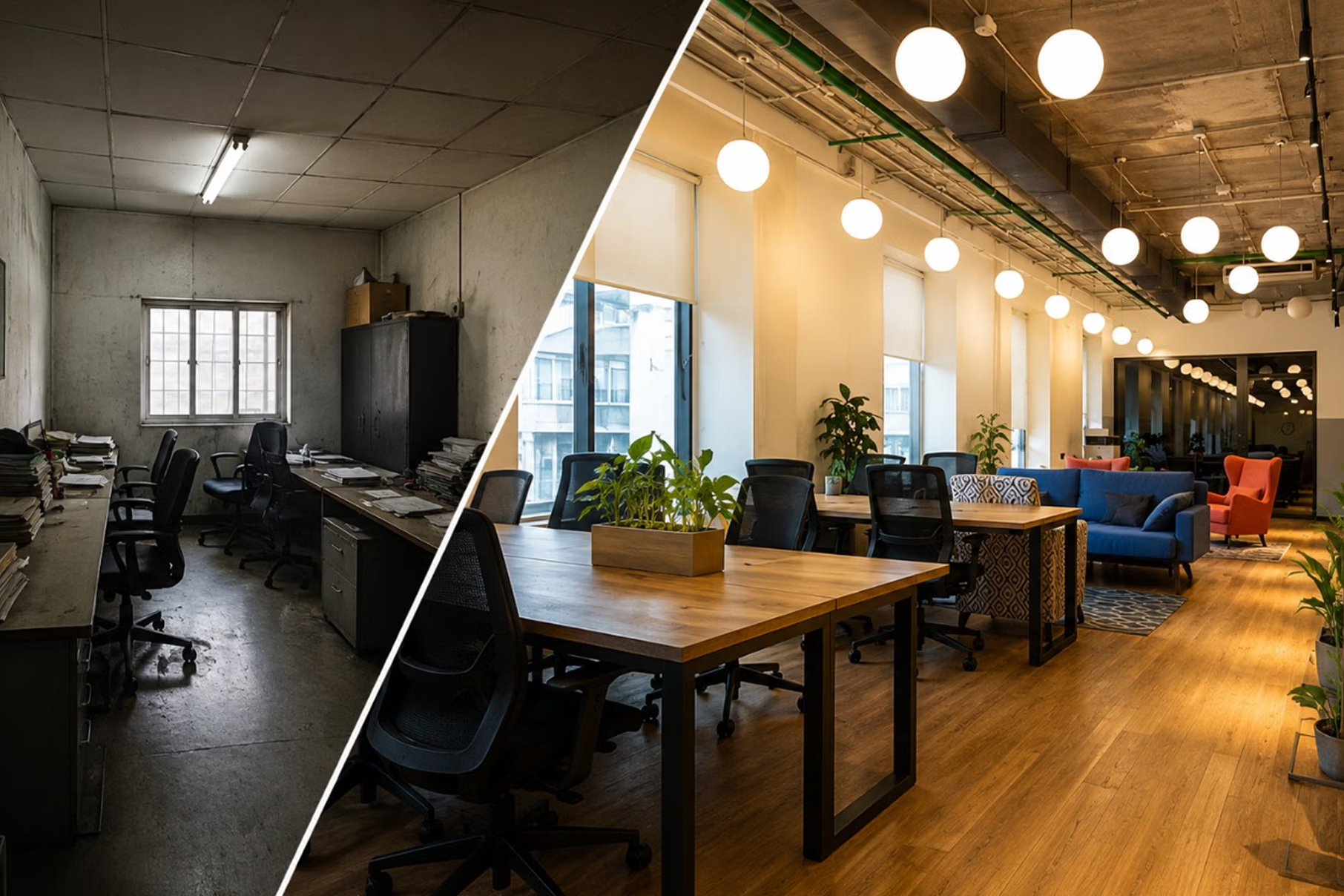
Agony. As founders spend days and weeks together to hire members, formulate a pricing strategy, and start raising funds for a big product push. But, very few have the mindfulness to think about the room that accommodates all these operations. Your Office.
The office space is doing more to you than you realise.
There's a body of research in environmental psychology that's been quietly building for decades, and the core finding is uncomfortable for anyone who's been ignoring the problems with their workspace. The physical conditions around you affect your mood and therefore, your decision making skills. Noise levels, visual clutter, infrastructure reliability, even how much natural light reaches your desk are active inputs into every judgement call you make.
The concept at the centre of this is cognitive load theory. Your brain's working memory has a finite capacity. When the environment around you keeps feeding it irrelevant signals, an unresolved noise, a flickering screen, a connectivity issue that's been annoying you since 9 AM, it processes all of it, quietly, whether you want it to or not. And every bit of capacity spent on that is capacity that isn't going into the strategic thinking you're actually there to do.
What Cognitive Load Has to Do With Your Office
Your brain's working memory is not a big space. It can hold only so much information at once before the quality of processing starts to drop.
You use a small amount of this working memory every time you even have to make a small decision about some unresolved noise or infrastructure problem in your office. They may seem like small decisions but when they keep piling up on top of one another, it can really affect the way you make decisions.
Research on cognitive load and decision-making published by the Global Council for Behavioral Science is direct about this: when working memory capacity is exceeded, decision quality deteriorates in predictable ways. Simplified thinking replaces nuanced analysis. Biases get amplified. Complex trade-offs get avoided. And crucially, speed suffers because the brain is essentially working harder just to stay functional, let alone sharp.
Your bet on the most controllable element in your office space is the design. If your workspace is well-designed, it is said to have a positive effect on your cognitive capabilities. Of course, it doesn’t have anything to do with the tasks at hand, but a good design will indirectly contribute to your team’s brain power.

Impact of Office Design on Employee Productivity
Noise is the most studied and most underestimated variable in workspace productivity. It doesn't just annoy people. It fragments their thinking at a neurological level. Conversations within earshot are especially disruptive because the brain automatically attempts to process language, even when you are trying to ignore it. That is not a matter of willpower. It is how the brain is wired.
What workplace distractions can mean in practice:
Office noise can make concentrated work harder, particularly when nearby conversations are clear enough to draw attention away from the task at hand. Visual clutter can create a separate source of distraction by adding more information for the brain to process.
For a founder or CXO, repeated interruptions during strategic work can make it harder to maintain concentration and follow complex discussions. A noisy meeting room, an unexpected facilities issue or a lack of privacy can pull attention away from the decision being made.
A secure, spotless, acoustically managed workspace is not a comfort preference. For leaders, it is an office design impact on decision making.
Why Your Physical Layout Is a Decision Architecture
Every design element in an office either aids or resists thinking. Most founders know this vaguely. Very few have sat down to map it.
Take something as basic as the private cabin versus open-floor debate. Open layouts can support collaboration and quick conversations, but they may not suit every type of work.
- Acoustic distraction is one consideration. Nearby conversations, calls and general office noise can interrupt tasks that require sustained concentration or confidentiality.
- Visual distraction is another. Movement, busy surroundings and constant activity within a person’s field of view can repeatedly compete for attention.
Private cabins and quiet zones give teams an alternative when the task requires deeper focus, sensitive conversations or fewer environmental interruptions. The goal is not to eliminate open spaces, but to provide different settings for different kinds of work.
Then there is the question of infrastructure reliability. A slow connection during a client call, repeated Wi-Fi drops during a presentation or unreliable meeting-room technology can interrupt the work itself and force the team to spend time troubleshooting instead.
When these issues happen repeatedly, they create unnecessary operational friction. Reliable internet and functional workplace infrastructure help reduce those interruptions and allow teams to stay focused on the work in front of them.
Your Office Should Be Working as Hard as You Are
Beginest offers fully managed, plug-and-play workspaces built for founders and
CXOs who need clarity, not chaos.
8 locations across Bangalore, including Indiranagar and MG Road.
The Environments Where Leaders Think Best
There is a concept in environmental psychology called restorative space. Spaces that allow the brain to shift gears, recover attention, and re-enter focused thinking with full capacity. This matters enormously for founders and CXOs who routinely move between deep work and high-frequency decision-making across the same day.
The characteristics of restorative, decision-supportive environments are well-documented:
- Low visual complexity with clear sightlines and uncluttered surfaces, reducing baseline extraneous load
- Acoustic control that allows speech privacy for sensitive conversations
- Consistent lighting that supports sustained focus without eye strain or fatigue
- Reliable infrastructure so that operational issues never consume the mental space meant for strategy
- Proximity to an engaged community that provides ambient professional energy without intrusive noise
What research tells us about design and performance:
Real-world research shows that workspace design can influence how people communicate, concentrate and perform.
- A 2018 field study by Harvard researchers found that when two organisations moved from traditional offices to more open-plan layouts, face-to-face interaction fell by approximately 70%, while electronic communication increased. The finding challenges the assumption that simply removing physical boundaries automatically improves collaboration.
- Three field experiments published in the Journal of Experimental Psychology: Applied in 2014 examined commercial offices in the UK and the Netherlands. Researchers found that enriching lean offices with plants improved workplace satisfaction and concentration, with the researchers reporting that productivity could increase by around 15% in the greener office environment.
- The Harvard Global CogFx study, involving 302 office workers across six countries, including India, found that higher levels of fine particulate matter (PM2.5) and lower ventilation rates were associated with slower response times and reduced accuracy on cognitive tests. This highlights how indoor environmental quality can influence concentration and cognitive performance during the workday.
The pattern across all of this research is consistent. Some interior design for small office space could create environments engineered for clarity and produce clearer thinking. That clarity shows up as faster, better, more confident decisions.

What a Managed Workspace Actually Gives Founders
When founders and CXOs move into a fully managed coworking space, some of the most immediate benefits are operational: meeting rooms are available when needed, core infrastructure is managed and routine facilities issues require less involvement from the leadership team.
Think of it like reducing the number of background tasks competing for attention. When a founder no longer needs to follow up on a maintenance issue, coordinate housekeeping or troubleshoot basic office infrastructure, that is one less operational task competing with the work they actually need to lead.
A managed workspace cannot remove every distraction, but it can reduce the amount of day-to-day facilities management handled internally.
Beginest was built around this exact logic. True plug-and-play workspaces across 8 locations in Bangalore, including prime spots in Indiranagar and MG Road, designed so that founders and CXOs can walk in and be in high-performance mode from the first hour. Private cabins for the days that call for deep thinking. Meeting rooms for the conversations that shape direction. A community of 200+ startups and 1000+ members who bring professional energy without becoming a distraction.
The metro connectivity matters too, and more than most leaders acknowledge. A 75-minute commute in Bangalore traffic before a high-stakes decision is not a neutral event. It costs physiological energy that should be going into the meeting. Locations close to metro lines protect that energy. That is not a small thing.
The Design Principle Founders Overlook Most
Founders often evaluate a workspace primarily through rent and convenience. But the lowest-priced option may carry other forms of friction: an unreliable connection, limited privacy, a difficult commute or an environment that makes concentrated work harder.
So, a cheaper desk is not necessarily a better-value desk. The more useful comparison is between cost and the working conditions included with it.
A workspace with acoustic privacy, reliable infrastructure and a professional environment can help reduce avoidable friction during the workday. The right choice depends on what the team needs to work effectively, not simply which option has the lowest headline price.
A cluttered workspace is a browser with 40 tabs open.
Close the background processes. Private cabins, high-speed internet,
spotless spaces — built so your best thinking has room to run.
Design Your Environment Like You Design Your Strategy
The best founders know that execution is a product of conditions, not just intentions. You can have the sharpest mind in the room and still underperform if your environment is silently taxing your cognitive capacity all day.
Choosing the right workspace is one of the few decisions with no downside. Get it right and it multiplies every hour of leadership time. Get it wrong and you pay a tax on every decision made inside it, without ever seeing the invoice.
Beginest's fully managed offices across Bangalore are built for this. Secure, spotless, wired for speed, and located where your team can actually get to without being drained before they arrive. Eight locations. One clear purpose.
Frequently Asked Questions
1. How does office design directly affect decision-making speed for founders?
Office design affects cognitive load, the amount of mental effort the brain expends just to process its environment. A cluttered, noisy, or unreliable workspace forces the brain to spend cognitive resources on background processing that has nothing to do with the decision at hand. This slows thinking, amplifies biases, and increases the chance of errors. A clean, managed, acoustically controlled workspace for founders reduces that overhead and returns that mental bandwidth to strategic thinking, directly improving both the speed and quality of decisions made.
2. Why are private cabins in coworking spaces better for high-stakes work?
Private cabins provide acoustic privacy and visual calm, two conditions that research consistently links to better executive function. For CXOs and founders doing concentrated work, like evaluating financial models, preparing investor narratives, or making hiring calls, an open floor introduces continuous low-level distraction that degrades thinking quality without the person necessarily noticing it. A private cabin is not about status. It is about protecting the quality of the work that shapes the company.
3. What role does internet reliability play in cognitive performance at work?
Every time connectivity fails, even briefly, it creates a micro-stress event that draws on working memory and attention. Over a full workday, these small interruptions accumulate into meaningful cognitive fatigue. High-speed, reliable internet is therefore not just an operational requirement. It is cognitive infrastructure. In a managed office space in Bangalore built for professional use, dependable internet is a standard. It removes one of the most common background stressors for teams that move fast.
4. How does a coworking community affect a founder's productivity and thinking?
A well-curated entrepreneurial coworking community provides ambient professional energy that research links to higher motivation and better work quality. Being around other founders and operators who are building things creates productive social pressure without becoming a distraction. It also accelerates informal knowledge exchange, the kind of conversation that happens between meetings and often contains the most valuable insight. Beginest's network of over 200 startups and 1000 members across Bangalore is built on this principle.
5. Why does office location near metro stations matter for a CXO's performance?
A long or physically taxing commute consumes physiological and cognitive resources before the workday even begins. Arriving at a high-stakes meeting already drained by 90 minutes in traffic is not a neutral starting point. Coworking spaces near metro stations in central locations like Indiranagar and MG Road make commutes predictable, faster, and less depleting. For leadership, this is not a convenience feature. It is a real input into the quality of thinking and decision-making that happens in the first hours of the day.